Where a six-unit townhome deal lost its margin

Dave Guiness
I underwrote financing for a six-unit for-sale townhome project in the Mountain West. The package did not hold up.
The sellout was in the mid-$3 millions. Here is where it went.
| Approx. % of sales | |
|---|---|
| Sellout | 100% |
| Less: land and finished pads | 21% |
| Less: vertical and soft costs | 60% |
| Less: financing | 8% |
| Less: selling cost | 6% |
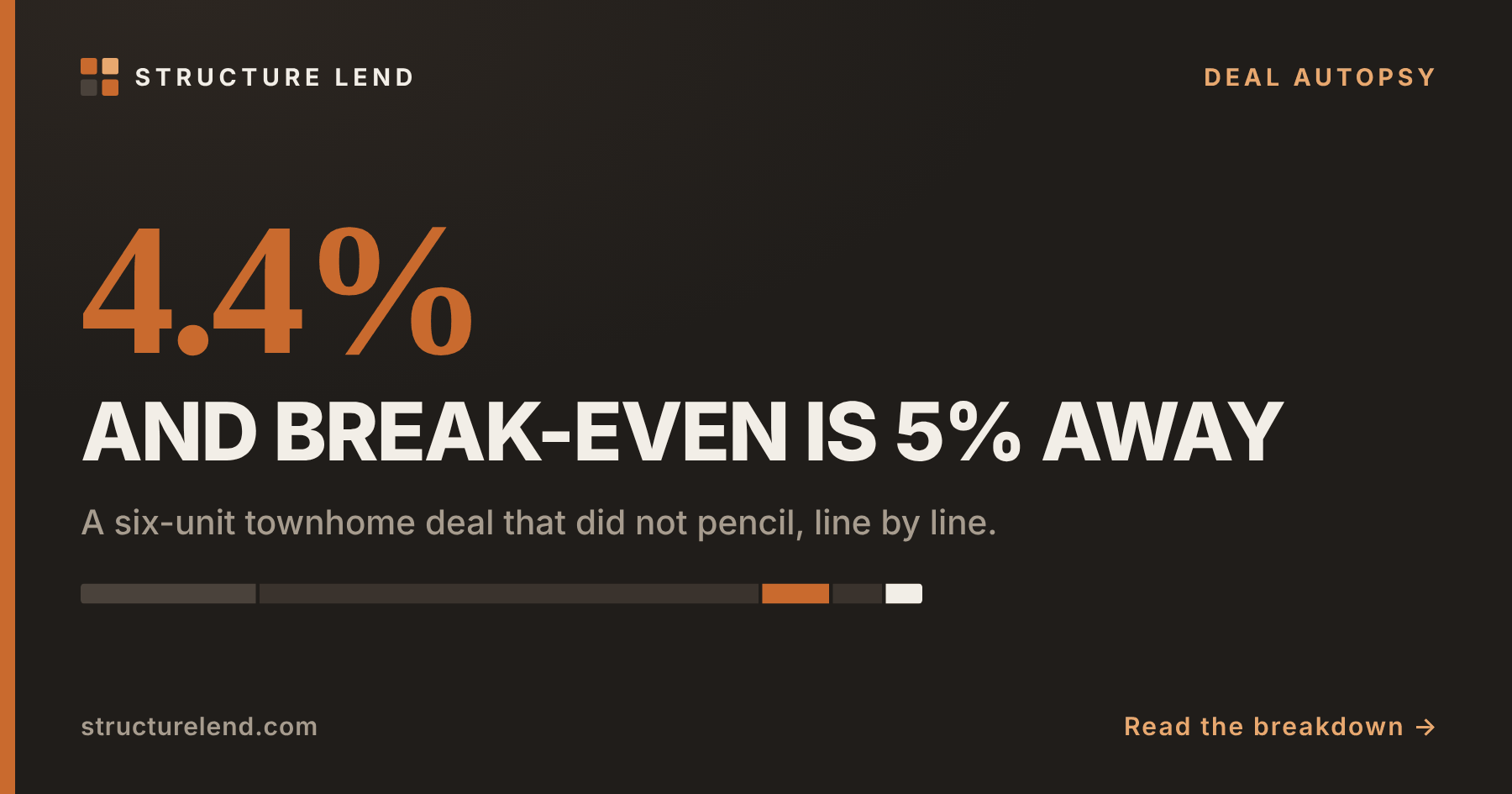
| Net margin | 4.4% |
That is roughly $28,000 per unit.
Why 4.4% is a no
Break-even sits only about 5% below the underwritten price. That is the whole story in one sentence.
A 5% cushion does not cover a slower sales pace. It does not cover a modest overrun. It does not cover a 7% cost of sale instead of 6%. Any one of those, by itself, takes the deal to zero. You do not need two of them to show up.
Compare the stack to one that works. On a deal I would finance, financing lands near 5.5% of sales and the net margin near 10%. Here financing is 8% and the margin is 4.4%. The financing line is larger than the profit line by almost a factor of two.
I wrote about how that stack is supposed to come together in Solving for the lot. This project is what it looks like when it doesn't.
What broke the underwriting
Absorption was too fast for the location. The schedule assumed units moved at a pace the submarket has not shown. A realistic sellout stretches the hold, and a longer hold increases carry. Private capital increases it further than a bank line would. So the financing line, already at 8%, was understated on top of being high.
The appraisal did not haircut comps from superior locations. Comparable sales were pulled from locations that command a premium this site does not. Nothing was adjusted down for that. The supported value was therefore optimistic before a single assumption about cost or timing was tested.
Sales and closing costs were understated. Six percent does not reflect what it actually takes to close a unit in this market right now. Concessions are real. Rate buydowns are real. Put a 7% cost of sale in and the margin is gone.
Notice that two of the three are timing and pricing assumptions, not hard costs. The vertical budget was not the problem.
The competitive overlay
There is one more thing, and it sits outside the model.
Large builders in the same area are already competing with forward commitments. A buyer looking at this product can get a rate buydown from a national down the street. That is a price concession this sponsor has to match out of a 4.4% margin, and the national is matching it out of a thicker one with a cheaper cost of capital.
The deal is not only thin. It is thin while competing against better-capitalized product.
What to check on your own deal
Run break-even as a percentage, not a dollar figure. Know how far the price can fall before profit is zero. If that number is inside 10%, you are not underwriting a margin, you are underwriting a hope about the market.
Test absorption against what the submarket has actually done. Not what the broker's pro forma says, and not what the last cycle did. Then re-run the carry at that pace.
Read the appraisal's comp adjustments, not just the conclusion. Where the comps came from and what got adjusted tells you more about the value than the number on the cover page.
Put your real cost of sale in. Including concessions and buydowns, at the level you are paying today.
A lender is going to do all four of these before committee. There is no advantage in finding out what they conclude after you have the land tied up.
Dave Guiness is the founder of Structure Lend, an independent capital advisory practice placing debt and structured capital for homebuilders and land developers. He has worked both sides of a builder's capital stack: underwriting and structuring loans at Zions Bank for the bank's most important relationships, originating at Builders Capital where he opened the Utah market from zero, and the finance seat on the sponsor side at Black Oak Development, capitalizing Keetley Ridge in Park City from raw land through completion. He has originated about $200 million since 2021. He holds dual master's degrees from Texas A&M in Real Estate and Land Development.
Want to talk? 801-372-8857. Or send me an email.